
Fractional COO vs. Full-Time COO: What Founder-Led Businesses Actually Need
There's a moment most founders recognize: you're the one who knows how everything works, approves every decision, and fills every gap — and it's starting to cost you. Projects stall. Your team waits on you. Growth feels less like momentum and more like pressure you can't quite get out from under.
When that moment arrives, two paths forward usually surface. You could hire a fractional COO — an experienced operations executive who works with you on a part-time or project basis. Or you could bring on a full-time COO, a senior hire who joins your team and takes on the full operational load. Most founders aren't sure which one fits. This post breaks it down clearly so you can stop guessing.
What Is a Fractional COO?
A fractional COO is a senior operations executive who works with your company on a retainer or contract basis — embedded in your leadership team, but not a full-time employee. They typically work with multiple clients at once, dedicating a set number of hours or days per week to each engagement.
What sets a fractional COO apart isn't just the arrangement — it's the experience they bring to it. A strong fractional operator has usually built and fixed operational systems at multiple companies across industries. They've seen the same breakdowns before. They know what good looks like at your stage. That pattern recognition is often the most valuable thing they offer.
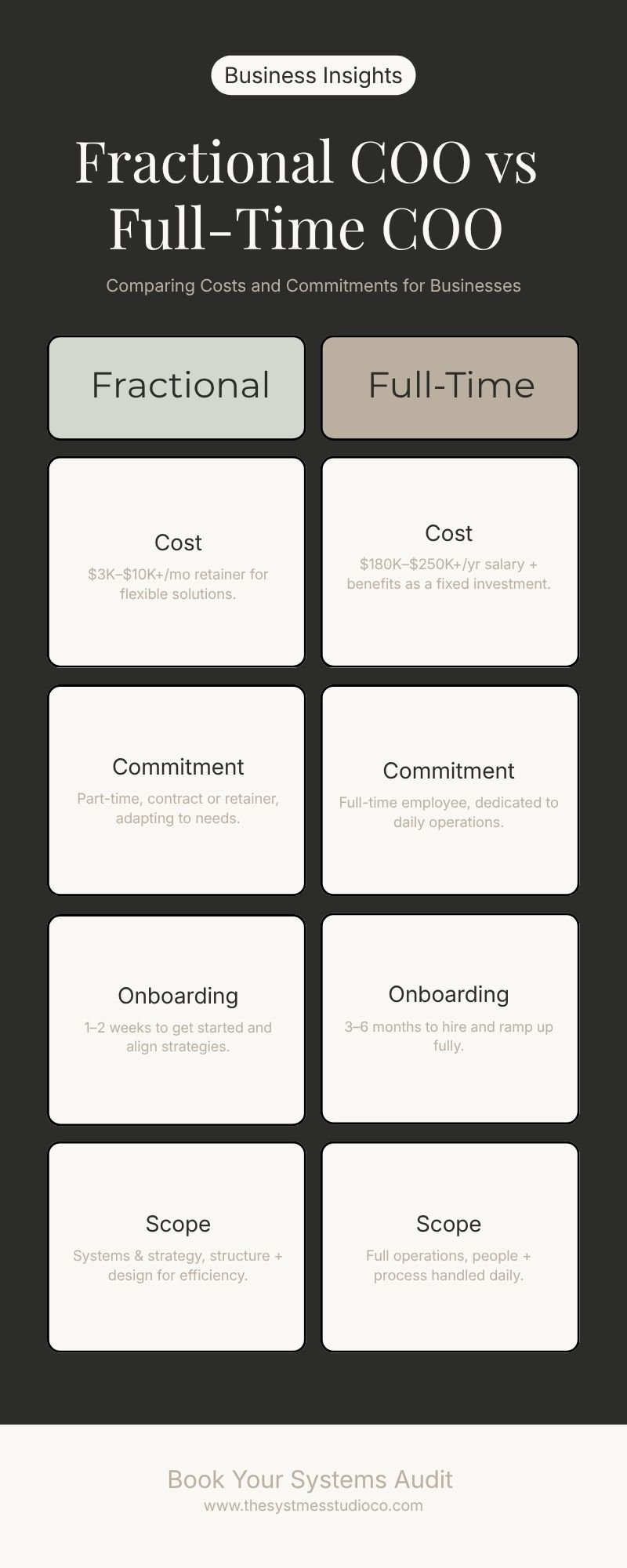
Because they're not full-time on payroll, fractional COO services typically run far less than a full-time executive hire — and they're available faster, without the months-long search and onboarding process.
What Is a Full-Time COO?
A full-time COO is a salaried executive, fully embedded in your business and on your payroll. They manage the entire scope of operations — people, process, delivery, and often finance — every day, full-time.
Hiring at this level is a significant commitment. Compensation for an experienced COO typically runs $180K–$250K+ in base salary, plus benefits, equity, and recruiting costs. The search alone often takes three to six months.
The right full-time COO is a powerful hire — when the business is ready for it. That usually means you're at $5M+ in revenue, running a team of 20 or more, and your operational complexity genuinely requires someone fully dedicated to managing people and process at scale.
Fractional COO vs. Full-Time COO: Key Differences
When Fractional Makes Sense
This is you if:
Your revenue is between $200K and $3M. You're past the scrappy startup phase but not yet at the scale that justifies a $200K+ executive on payroll.
Your team is 3–12 people. Things are complex enough that you can't manage everything yourself — but not so large that you need someone dedicated full-time to people management.
You run a service-based business. Delivery, client experience, and team coordination are core to your operations. A fractional COO can systematize these without disrupting what's already working.
You're the bottleneck. Every decision runs through you. Your team is capable, but the structure isn't there to let them move without you.
You're not ready to hire permanently — yet. You want operational expertise now, without the overhead, risk, or months-long search.
A strategic systems audit with a fractional COO can often surface what's actually breaking before you've committed to a long-term hire of any kind.
When Full-Time Makes Sense
A full-time COO becomes the right call when the complexity of your operations genuinely demands someone on the ground every day. That typically looks like:
Teams of 20 or more, with multiple departments or functional leads who need daily coordination and management
Revenue of $5M+, where operational decisions carry enough financial weight that you need dedicated, full-time attention
Multi-layered operations — multiple product lines, locations, or delivery systems running simultaneously
A founder ready to step fully out of the operational role, and handing off to someone who can own it completely
At this stage, the cost of a full-time COO is justified by the complexity they're managing. Before that stage, you're often paying full-time rates to solve part-time problems.
What to Watch Out For With Fractional
A fractional COO is not an all-purpose operations hire — and confusing the two is one of the most common mistakes founders make.
The right fractional operator designs systems, builds structure, and creates the clarity that lets your team operate without you. They're not there to manage your inbox, handle day-to-day admin, or fill execution gaps. If what you need is someone to complete tasks rather than build the engine, a different hire fits better.
Similarly, a fractional engagement requires your participation. This person is working with your business on a limited schedule — the faster they can get access to your team, data, and context, the faster things improve. Founders who treat fractional support as a hands-off handoff often see slower results.
When it works well, a fractional COO effectively designs the engagement around your specific stage and bottlenecks — then builds toward something that can run without them.
What Changes When This Works
Founders who have worked with the right fractional COO often describe a version of the same shift. The noise quiets. Decisions stop funneling through you by default. Your team knows what to do, how to prioritize, and who owns what — without asking.
In practice, that looks like:
Fewer daily decisions landing on your plate. Your team has the context, the process, and the authority to move.
Reduced dependency on you as the operating system. You stop being the person everyone waits on.
Predictable timelines. Projects finish when they're supposed to. Delivery doesn't rely on heroics.
Room to work on the business instead of in it. Strategy, relationships, and growth become things you actually have time for.
The goal of good fractional work isn't to make you dependent on a fractional COO indefinitely — it's to build the operational foundation that makes your next stage of growth possible.
Not Sure Which One You Need?
Most founders don't need to know the answer before they get on the phone. The right operations partner can help you figure it out — including whether the answer is fractional, full-time, or something else entirely.
Book a free Discovery Call and we'll help you map what you actually need — even if that's not us.
Frequently Asked Questions
How much does a fractional COO cost compared to a full-time COO? A fractional COO typically runs $3K–$10K+ per month on retainer, depending on scope and hours. A full-time COO costs $180K–$250K+ annually in base salary, plus benefits, equity, and recruiting fees. For most founder-led businesses under $5M in revenue, fractional delivers the expertise at a fraction of the cost.
Can a fractional COO be a long-term solution? Yes — and for many businesses, it's the right one indefinitely. If your operational complexity doesn't require full-time oversight, a fractional engagement can scale with you as your needs evolve. Many founders transition to full-time only when they've grown to the point where the fractional model no longer fits their scope.
What's the difference between a fractional COO and a business consultant? A consultant typically delivers a report or recommendation and exits. A fractional COO is embedded — they work inside your business, alongside your team, to implement and operationalize. The relationship is ongoing, not project-based, and the goal is measurable change, not a deliverable.
When should a startup hire a COO? Most startups are better served by a fractional COO until they reach $3M–$5M in revenue and 15–20+ team members. Before that stage, the cost of a full-time executive is hard to justify — and the right fractional operator can provide the same strategic impact at a fraction of the overhead.
